 Plants While Away
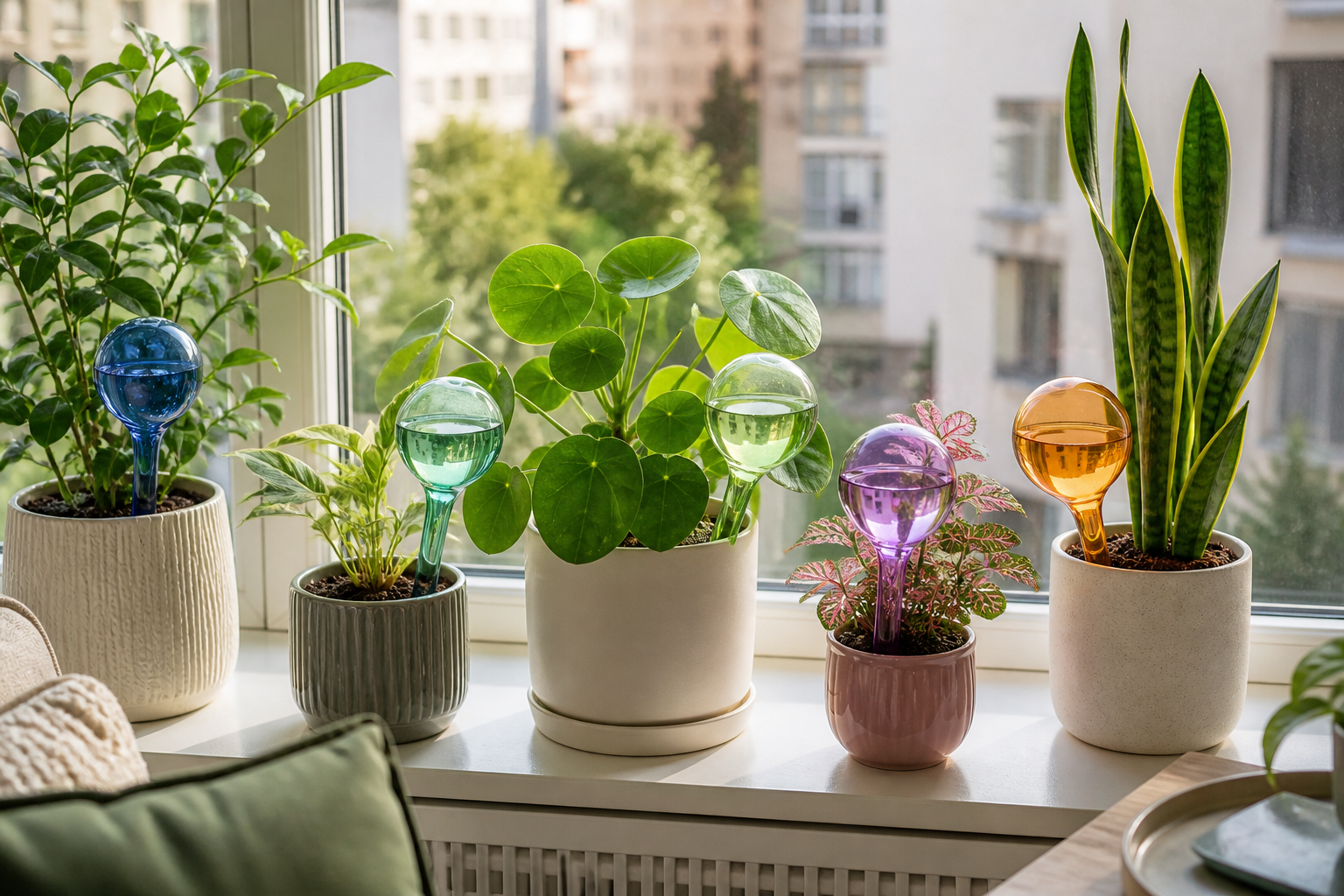
Watering Globes for Apartment Plants: What They Can and Can't Cover on a Week-Long Trip
A trip is coming up, a shelf of plants needs water, and those pretty glass bulbs keep showing up online. The question is whether they do anything at all.
They do. Watering globes move water into soil, and the mechanism behind it is real. Water sits in the bulb, the soil draws it out slowly as it dries, and air bubbles up through the stem to replace whatever leaves. None of that is marketing language. It is simply how a sealed reservoir with one small opening behaves against damp soil.
Runtime is the harder question, and it is where most advice falls apart. Claims range from a few days to a week to two weeks, and every one of them can be accurate or badly off, because the globe does not set the pace. The pot does. A 12 inch pot of fast draining cactus mix in a warm, sunny living room empties a globe far faster than a 4 inch pot of peat heavy mix in a cool bedroom, even though the product is identical.
So a week-long trip is realistic for some setups and not for others. The only way to know which one you have is to estimate coverage for the actual pots sitting in your apartment, before you book anything or buy anything.
That is what this guide does. Here is what is ahead:
- How a globe or bulb actually releases water, in plain terms, so you can tell when one has stalled or drained too fast.
- Four variables set the runtime: soil mix, pot diameter, globe capacity, and room temperature.
- A home test run that estimates coverage for each of your pots, with no math degree required.
- Where glass bulbs, terracotta inserts, and bottle-top spikes part ways in how they meter water.
- Matching globe count to plant count and pot size, since one bulb per plant is often the wrong number.
- The point where globes stop being the right tool and a reservoir-based system fits better.
By the end you will have a number for each pot, not a guess, and a clear sense of whether your plants can ride out the week on their own.
Run the test while you are home. A globe that drains in two days is useful information on a Tuesday, and a disaster on day one of a vacation.
- A globe releases water only as the soil near its stem dries and lets air bubble in, so runtime depends on your pot, not the product.
- Four variables set coverage: soil mix, pot diameter, globe capacity, and room temperature.
- Measure how many ounces each pot takes and how many days it lasts, divide for a per-day figure, then compare that to globe capacity.
- Wide pots usually need two medium globes on opposite sides rather than one large one; skip globes on cacti, succulents, snake plants, and ZZ plants.
- Past about a week, or with 10-inch-plus pots and fast drinkers, a wick, pump kit, or self-watering pot holds more water than any sealed bulb.
Reviewed by — contributors with hands-on preparedness experience. How we test
Watering globes do move water into soil, but your pot, soil mix, and room temperature decide how long one lasts. Here is how to estimate coverage for your own plants before a week away.

Self Watering Globes for Plant, 10pcs Auto Watering Bulb for Indoor Outdoor
Ten glass bulbs for indoor or outdoor pots, enough to cover a small collection and double up on a thirstier plant. Glass lets you mark and read the water line during a pre-trip drawdown trial.
Check Price on Amazon
Plant Watering Globes Set of 6, Small - Glass Self Watering Globes
Set of six small glass globes sized for 4 to 6 inch pots, where a full-size globe would tip the plant or crowd the root ball.
Check Price on Amazon
SmartiLiving Ollas (Set of 4) | 12oz Terracotta Plant Watering Globes - Self Watering Planter Insert - Automatic Plant Watering Devices | Vacation Watering Pots for Indoor & Outdoor Plants
Four unglazed terracotta ollas at a stated 12 oz each, seeping through the whole clay wall instead of one stem opening. Useful in medium and large pots where one small bulb runs dry too soon.
Check Price on AmazonIn this guide
How a Watering Globe Actually Releases Water
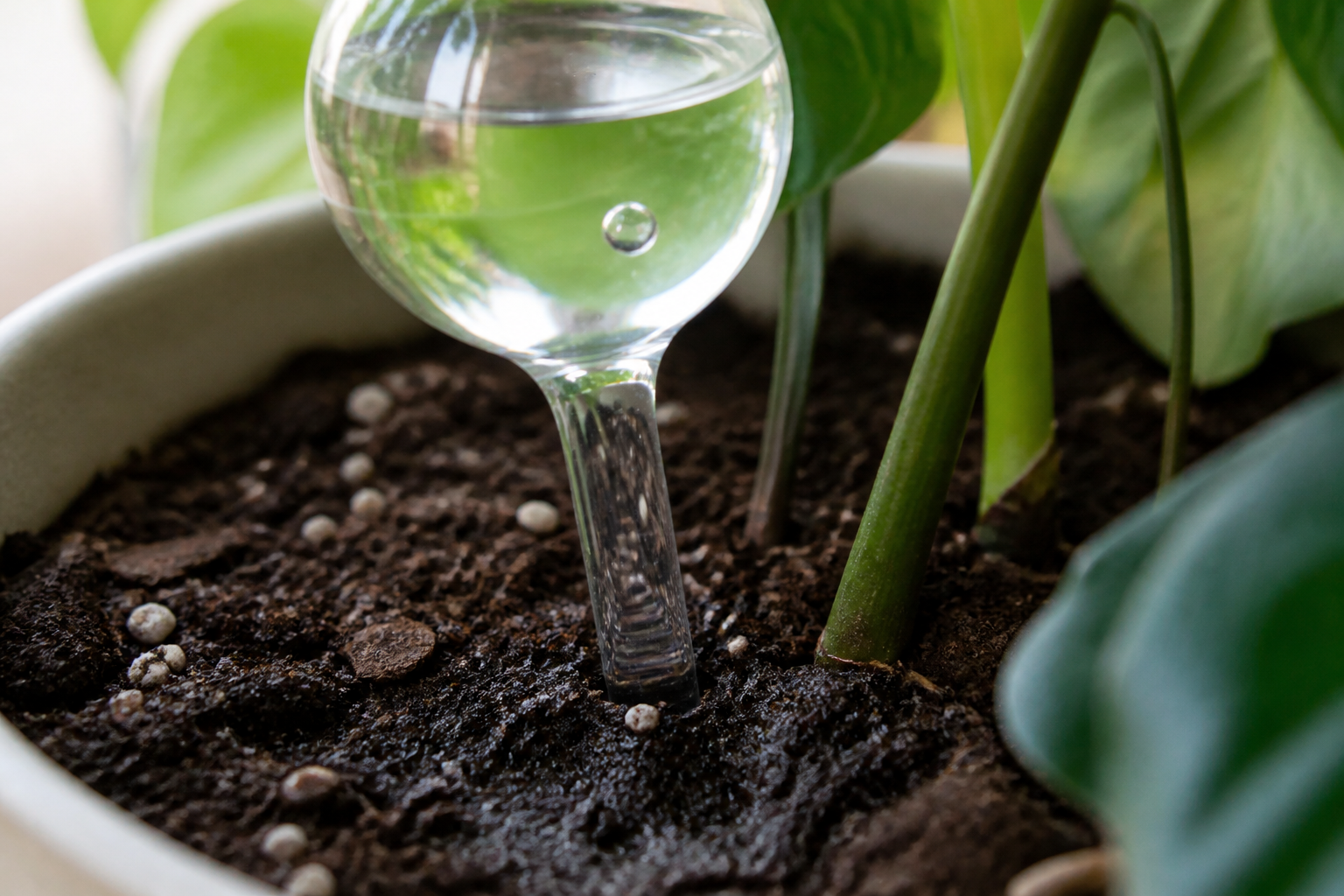
Picture a container with a long, narrow stem. Fill the bulb, flip it over, push the stem into the soil, and from that point nothing moves until air can get in.
That exchange is the whole trick: water leaves the globe only when air enters to take its place. Because the stem opening sits buried in the soil, wet soil seals off the air supply. Dry soil, by contrast, has open pockets between particles that let air slip up into the stem. Each rising bubble releases a little water, and then the cycle repeats.
A globe is not watering on a schedule, then. It responds to how wet the soil is right at the stem opening, unlike a timer, which releases a set amount at a set hour no matter what the soil is doing.
Why the same globe empties at wildly different speeds
Insert a globe into soil you just soaked and almost nothing happens, because there is no room for air and the water simply sits. Move that same globe into dry, loose, chunky mix and it can drain in a day, since coarse mix is full of air gaps and cannot hold water back.
Pre-watering matters for exactly that reason. Soak the pot thoroughly, let it drain, and only then insert the globe. Gardeners have passed this advice around for years because bone dry soil at the start costs you most of the globe’s water in the first few hours. Starting damp leaves the globe a job it can do slowly.
Common ways globes stop working
Three failure modes show up again and again in reports from people who use globes.
- Clogged stems. Soil packs into the narrow opening and seals it, so flow stops and the globe sits full for days.
- Air locks. The reverse problem: air cannot break in at all, so the water never moves even though the soil has dried.
- The initial gush. Push the stem into coarse or very dry mix and it dumps a slug of water immediately, often more than the plant needs at once.
None of these are rare. For a device with no moving parts, they are simply the normal range of behavior, and recognizing them tells you what your own pots are doing.
The pace is set by conditions outside the globe itself.
The Four Variables That Decide How Long a Globe Lasts
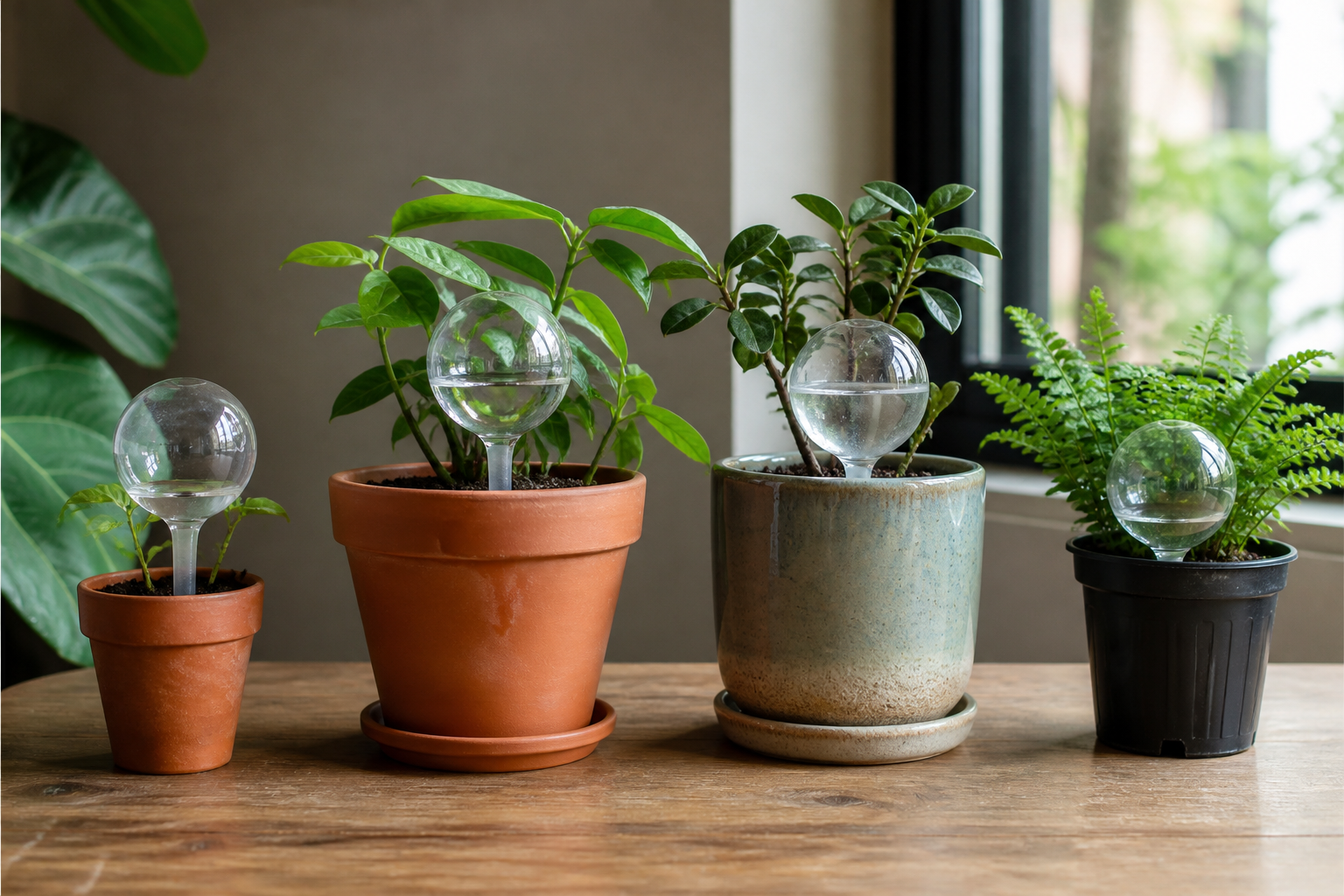
Runtime claims range from a few days up to two weeks. Those numbers do not prove that one globe outperforms another; they mostly reflect differences in pots, soil, and rooms. Four things decide what happens in your apartment.
1. Your soil mix
Soil controls how fast water leaves the stem, because water only moves out once the soil touching that stem is dry enough to pull it.
Peat-heavy potting mix grips water and stays damp for a long time, so the globe releases slowly and runtime stretches out. The tradeoff is soil that sits wet too long, the main overwatering problem with passive systems.
Chunky aroid mixes with bark and perlite, along with gritty cactus mixes, behave the opposite way. Fast drainage and big air pockets let water run past the stem rather than stay pressed against it, so globes often empty faster in these mixes, sometimes in a rush.
2. Pot diameter and soil volume
A globe holds a fixed amount of water, and the pot decides how far that water has to spread.
In a small 4 or 6 inch pot, a globe makes up a large share of the soil’s total water and can cover several days. Put the same globe in a 12 inch pot and it amounts to a small top-up, with the surrounding soil drying while the globe barely dents it.
Soil volume matters more here than the plant sitting in it. Two pots can measure the same across the rim, and the deeper one will still hold far more water.
3. The globe’s own fill volume
A few ounces is all a small decorative bulb holds, while larger globes and terracotta inserts carry more than that. Whatever the number is, it caps how long the globe can run. No amount of clever placement or soil tweaking will get a small bulb to deliver more water than it contains.
Stated capacity is the first spec worth checking on any listing. That figure tells you more about how much of your trip gets covered than a marketing duration claim does.
4. Temperature, airflow, and light
Heat, direct sun through a window, and moving air all pull water out faster. The plant drinks more while the soil surface dries off at the same time. Put a globe in a cool, shaded corner and it may run a week; move the same globe to a warm south-facing room and it can empty well before that.
All four variables pull on each other. At the fast end sits a chunky mix in a big pot beside a warm window; at the slow end, a dense mix in a small pot in a cool room. Someone else’s apartment therefore cannot tell you how long a globe will run in yours. Estimating for your own pots is the way to find out, and the next section walks through it.
Estimating Coverage for Your Own Pots
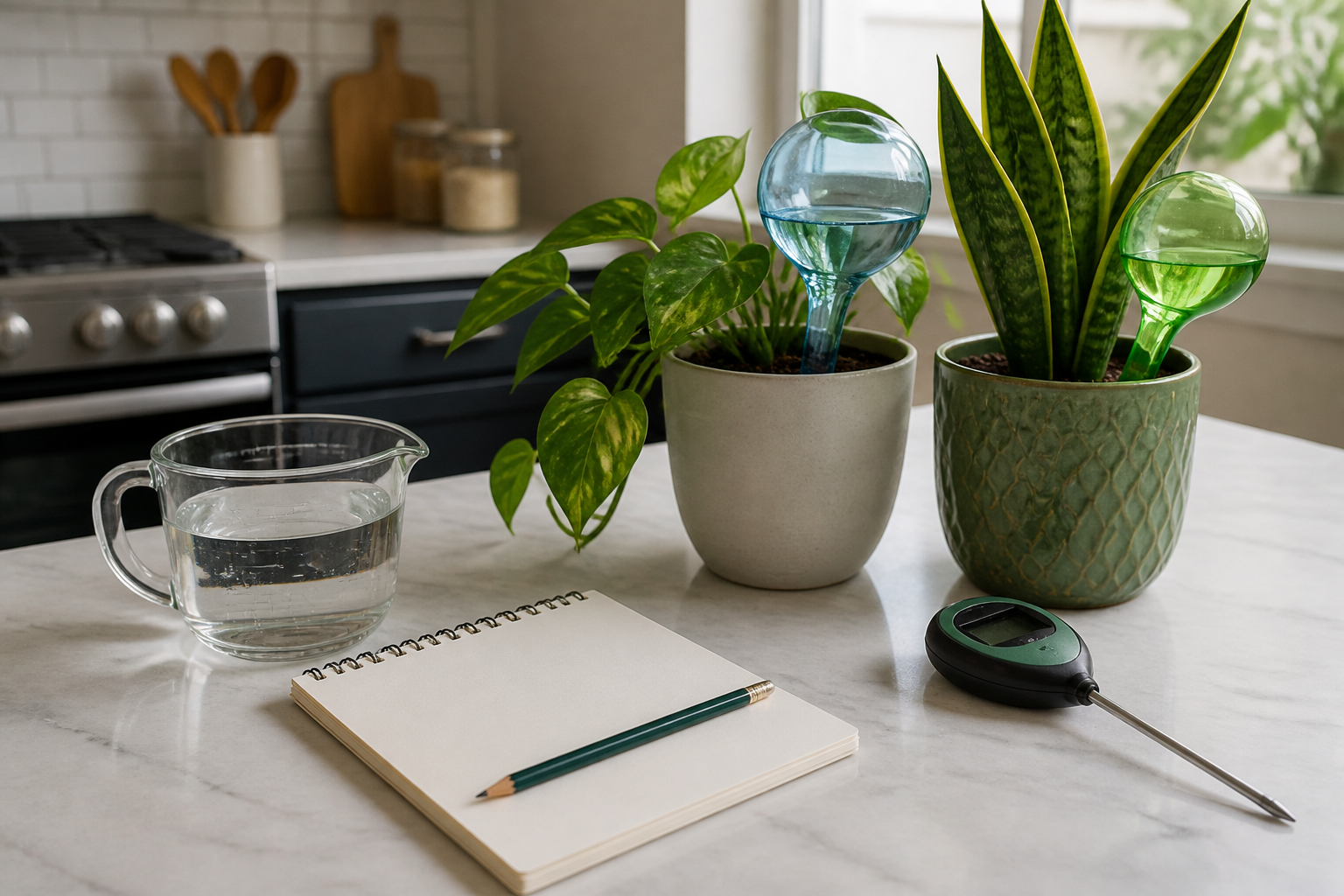
Guessing is avoidable. Measure what each pot actually drinks, then set that figure against what a globe holds. A measuring cup covers the whole job, and the arithmetic stays simple.
Step 1: Measure your normal watering volume
The next time a plant needs water, skip the watering can and fill a measuring cup instead. Add water until the first drops reach the drainage hole, then stop and record the ounces or milliliters it took. Repeat for every pot you plan to leave behind. A 4 inch pot and a 10 inch pot need very different amounts, so give each its own measurement.
Step 2: Count the days between waterings
Then track how many days pass before that same pot is ready again. Push a finger about an inch into the soil to check. Once that top inch feels dry and the plant wants more, count back to your last watering. Base the count on the current season rather than a memory of last winter, since a plant in a bright July apartment drinks faster than the same plant in November.
Step 3: Turn it into a per-day number
Divide the water volume by the number of days. If a pot takes 12 ounces and goes 6 days between waterings, that is 2 ounces per day. Multiply by your trip length. A 7 day trip means that pot wants about 14 ounces while you are gone.
Step 4: Compare that to one globe
Packages and product pages usually list globe capacity in ounces or milliliters. In the same pot, a larger globe holds more water and tends to run longer, while a smaller one balances more easily in a little pot but empties sooner. A set with more pieces covers several plants at once, or lets you double up on a thirsty one.
If your pot wants 14 ounces and your globe holds less than that, one globe will not cover the week on its own.
Step 5: Add a margin for warm rooms
Heat and dry air speed up water use. If your apartment runs warm while you are away, or you turn the air conditioning off to save money, plan for the pot to drink more than your measurement showed. A safe habit is to assume a globe will last less time than you calculated, not more.
Step 6: Run a short trial before the trip
This is the part that replaces guessing. Two weeks before you leave, water the pot well, then insert the filled globe. Put a strip of masking tape down the side of the glass and mark the water line with a pen. Check it at the same time each day for several days and add a new mark. You will see how fast the level drops in your soil, in your pot, in your room. If the globe is half empty after two days, you know a week is out of reach without help. If it has barely moved, the soil may be holding too much water, and you should check drainage before you commit to the setup.
Glass Bulbs, Terracotta Inserts, and Bottle-Top Spikes Compared
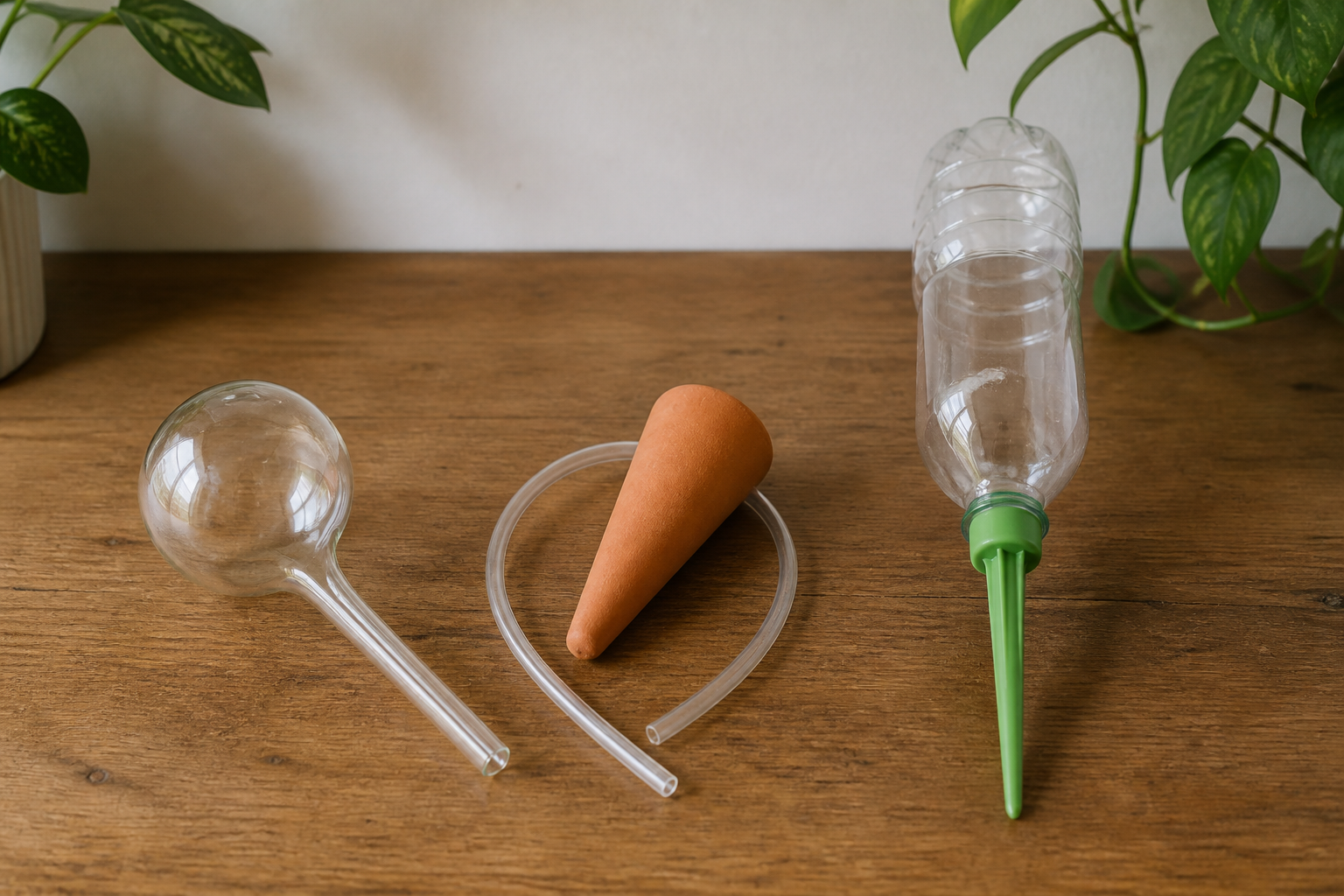
These three formats look similar on a shelf, but they move water in different ways. That difference matters more than color or shape.
A glass bulb is a sealed reservoir with one open stem. Water leaves through that stem opening only. Air has to push back in before more water can leave, so the flow comes in small bursts as the soil around the tip dries and loosens.
Porous clay works differently. An olla or clay spike is unglazed terracotta. Water seeps through the whole clay wall, not just one hole. The clay stays in contact with damp soil, and water moves out slowly along that contact.
That changes how each one behaves in your mix. In a chunky mix with bark, perlite, or pumice, a glass stem may sit in an air pocket and dump water fast. In the same mix, clay has more surface touching soil, so release tends to be steadier. In a fine peat mix, clay can stay wet and release slowly, while a glass stem may clog with packed soil and stop almost entirely.
Formats side by side
Capacity and material details above come from manufacturer listings. Most sellers publish a count and a size name without a tested runtime, so treat any stated day range as a rough starting point, not a promise.
Which ones take a bottle on top
Only the bare clay spikes accept a bottle. You fill a bottle, screw or press it onto the spike, and invert it. That gives you a bigger reservoir than any sealed bulb, which is the main reason people pick this format for longer trips.

20 Pack Terracotta Plant Watering Spikes, Self-Watering Stakes for Wine Bottles, Porous Clay, Reusable (Red A)
Check Price on AmazonSelf-contained ollas and lidded spikes hold a fixed amount. You refill them by hand, so their total volume is the ceiling.
SmartiLiving Ollas (Set of 4) | 12oz Terracotta Plant Watering Globes - Self Watering Planter Insert - Automatic Plant Watering Devices | Vacation Watering Pots for Indoor & Outdoor Plants
Check Price on Amazon
Glass bulbs are sealed units with no bottle option. They are the easiest to fill and the easiest to read at a glance, since you can see the water line through the glass.

Small glass bulbs suit 4 to 6 inch pots where a full-size globe would tip the plant or crowd the roots.
Whatever format you choose, fill it and watch it for two or three days at home before your trip. That is the only way to see how your actual soil responds.
Matching Globe Count to Plant Count and Pot Size
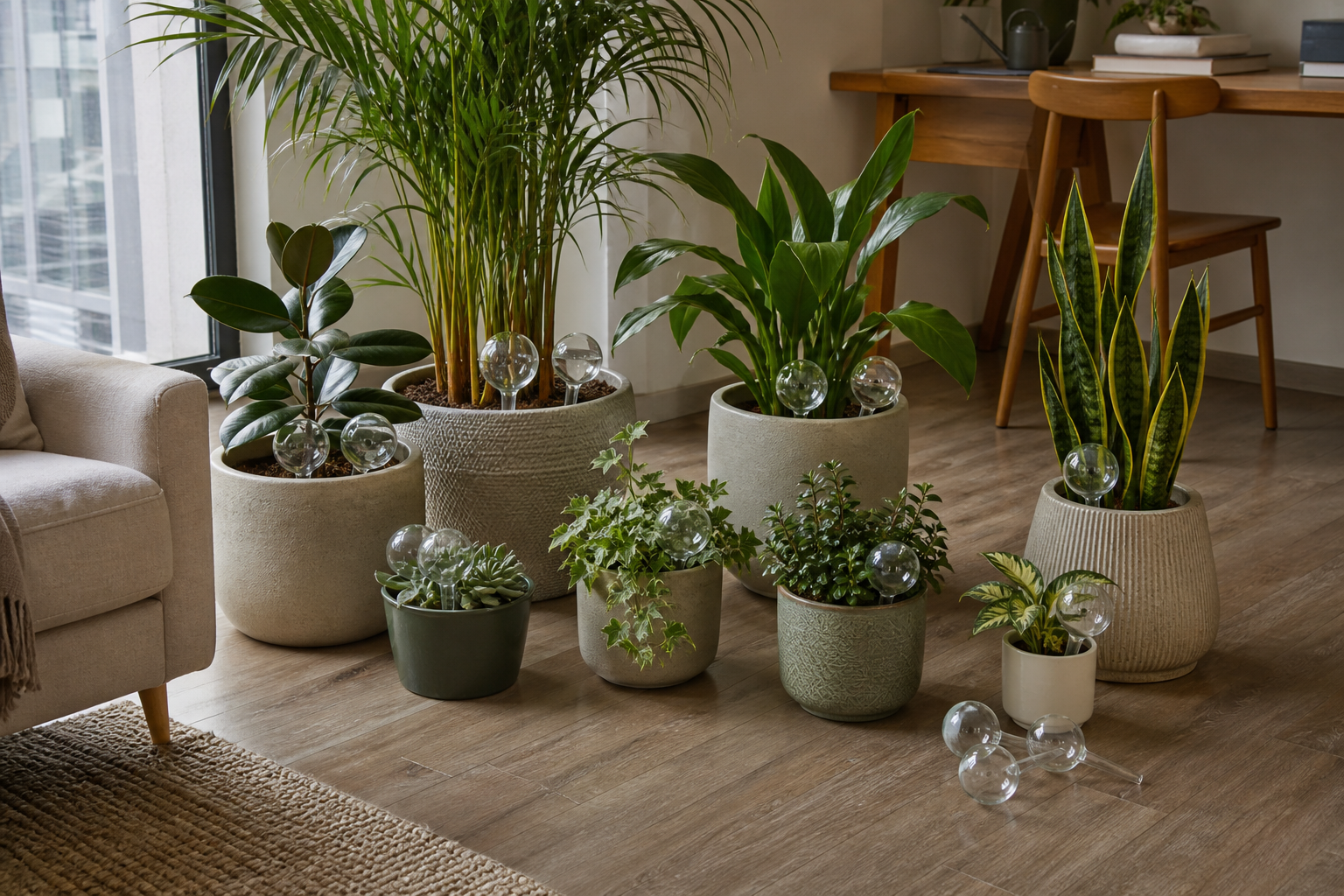
One globe does not mean one plant. It means one wet spot in the soil. That is the whole idea you need before you start buying.
Start with pot diameter
Measure across the top of each pot. Small nursery pots and 4 to 6 inch containers usually need just one small bulb. The root ball is narrow, so a single release point reaches most of it.
An 8, 10, or 12 inch pot is a different problem. Water from one bulb soaks the soil near the stem and spreads out only so far. The outer ring of soil can stay dry while the center stays soggy. Roots near the pot wall get nothing.
For those wider pots, two medium globes placed on opposite sides often behave better than one oversized globe. You get two smaller wet zones instead of one deep, heavy one. If one clogs, you have not lost all your coverage. A clay insert with a wider body also spreads moisture through the soil instead of dumping it in one channel.
Where to place the stem
Push the stem in about 2 to 3 inches, far enough that it stays put and stays surrounded by damp soil. Keep it 2 to 3 inches away from the main stem of the plant, closer to the halfway point between stem and pot rim.
If the pot is rootbound, do not force it. You will snap roots or the stem will hit a root and sit in an air pocket, which drains the globe fast. Water the pot well first, then work a pencil or chopstick into the soil to open a path. If you cannot find a soft spot, that pot is not a good globe candidate.
Terracotta spikes that screw into a bottle give you a larger reservoir per hole, which helps in a big pot where one small bulb runs dry too soon.
When the count stops making sense
Do the math before you commit. Twelve plants with a few large pots can mean 15 to 20 globes. That is a lot of filling, a lot of glass to store, and a lot of chances for one to fail quietly.
At that point, a reservoir setup or a self watering pot for your thirstiest plants is less work than managing a shelf full of bulbs.

Plants to skip entirely
Leave globes out of cacti, succulents, snake plants, and ZZ plants. They store water and do not want steady moisture. A week of constant damp soil does more harm than a dry week. Give them a good drink before you go and leave them alone.
When a Reservoir-Based Method Is the Better Fit
A globe holds a fixed amount of water. That is the hard limit. Once your plants need more water than the globe can hold, no amount of good setup fixes it.
You have likely passed that limit if any of these fit you:
- Your trip runs past about a week.
- You grow fast drinkers like ferns, calatheas, or a big pothos in bright light.
- Your pots are 10 inches wide or larger.
- Your apartment sits warm in summer, or you turn the air conditioning off while you are gone.
- You have more plants than globes you want to fill, check, and refill.
A reservoir method solves this a different way. Instead of one small glass body feeding one spot in the soil, you hold water in a jug, bucket, or tank. Capacity grows as the container grows. You can add water without adding more devices.
Wick cord drawing from a jug
A wick is a cord. One end sits in a water jug. The other end goes into the soil. Water travels along the cord as the soil dries. Nothing needs power, and you can run several cords from one jug.
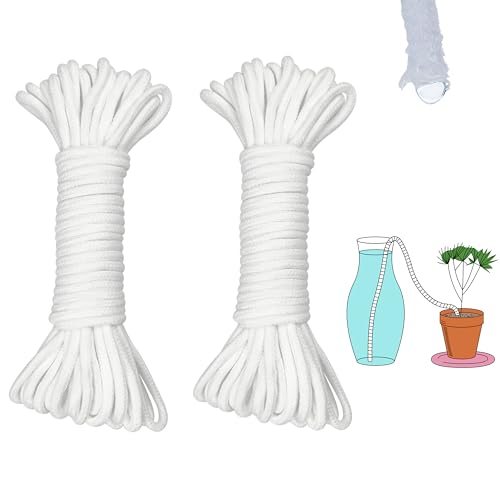
ORIMERC 60 feet 1/5 inch Self Watering Capillary Wick Cord Vacation Plant Sitter DIY Hydroponic Wicking Self-Watering Planter Pot Automatic Water System Device Potted Violet Auto Seedling Waterer Rope
Check Price on AmazonWicks move water slowly. They suit plants that like steady, even moisture better than plants that want a soak and then a dry spell.
Pump and tubing kits with a central tank
These use a small pump, thin tubing, and a timer. You set a watering time and length. The pump pulls from whatever container you choose, so a larger bucket means a longer trip covered.

Some kits are built to feed many pots at once and let you program the schedule.

Automatic Plant Waterer Indoor Self Watering System for 15 Potted Plants, Auto Drip Irrigation Kit Programmable Water Timer with Smart Humidity Detection, Green
Check Price on AmazonSelf-watering pots with a built-in reservoir
Here the reservoir is part of the pot. You fill a chamber below the soil, and the plant draws from it. There is no tubing to kink and no battery to die.
The trade is repotting time, plus a reservoir sized to that one pot.
The honest trade-offs
Powered systems have more parts, so they have more ways to fail. Common ones are batteries running down, emitters clogging with grit or mineral buildup, tubing slipping loose, and a pump running dry once the tank empties. Wicks can lose contact or dry out. Any system can leak onto a floor you cannot mop.
So run it before you go. Set it up at least a week early. Watch where water lands, check the soil, and note how much the reservoir drops each day. That number tells you if your tank covers your trip.
For a large collection, rare plants, or a trip of several weeks, a person who stops by is still the most reliable plan. A reservoir system and a sitter work well together. The system handles the daily work, and the sitter catches the failures.
Frequently Asked Questions
Why did my globe empty in a single day?
The soil around the stem was probably dry and loose. Air moved into the globe fast, so water poured out fast. Dry potting mix also pulls water away from the stem quickly, which keeps the flow going. Water the pot well first and let it drain. Then insert the globe. A big pot diameter and a warm, dry apartment speed this up too.
Why did my globe never drain at all?
The opposite problem. The soil stayed wet, so no air could enter the neck. Heavy mixes with lots of peat or coco coir hold water for days and stall the globe. A packed stem opening can also block flow. Pull the globe out, check the tip, and try it in soil that has dried out a bit near the surface.
Do watering globes cause root rot?
The globe alone does not. Soggy soil with nowhere to drain does. A globe keeps soil damp for a long stretch, which suits plants that like even moisture. Pair that with a pot that has no drainage hole and you have a real risk. Use pots with holes, empty any saucer before you leave, and skip globes on plants that want to dry out.
Do they work in cactus and succulent mixes?
Usually not well. Gritty, fast-draining mixes barely hold water, so the globe keeps feeding and the mix stays wetter than those plants want. Most cacti and succulents also handle a week alone with no help at all. Water them before you go and leave them be.
How do I stop the stem from clogging?
Fill with clean water, not leftover fertilizer water. Push the stem in at a slight angle so soil packs in less. Some growers cover the tip with a small piece of fine mesh or a nylon scrap. Terracotta spikes clog differently, since minerals can slowly seal the clay pores, so rinse them between trips.
Can I move one globe between pots?
Yes. Rinse it and refill. Just remember each pot has its own flow rate, so the runtime you saw in one pot will not carry over to another.
Is a wine bottle a workable substitute?
It can be, with a terracotta spike made for bottle necks. The bottle is just the reservoir. The clay tip controls the flow. A bare bottle jammed into soil tends to dump its water or clog.
Your Pre-Trip Globe Checklist
Work through this list in order. You can print this page and check off each step.
Two Weeks Before You Leave
- Measure what each pot drinks. Water one pot the way you normally do. Use a measuring cup and write down how much water it took and how many days it lasted. Do this for each plant.
- Pick your globe count and size. Match the total water each pot needs for your trip to the globe capacity you have. If one globe cannot hold enough, plan on two smaller globes in that pot instead of one large one.
- Check drainage first. Pour water in each pot and watch it exit the drain hole. If water sits on top or the hole is blocked, fix that now. A globe in a pot that cannot drain is the fastest way to lose a plant.
- Run a drawdown trial. Set up the globes exactly as you plan to use them. Fill them, mark the water line with tape, and leave them alone for several days. Check the line each morning. If a globe empties in two days, you know your real runtime before the trip, not after.
A Few Days Before
- Move pots out of direct sun and away from vents. Warm, bright spots speed up water use. A few feet back from the window slows the drain rate.
- Protect the floor. Put a saucer, tray, or towel under every pot. Globes can tip, and clay spikes can seep.
- Clear the globe stems. Rinse each stem and check for grit or dried soil. A clogged stem releases nothing.
The Morning You Leave
- Water every pot deeply first. Soak until water runs from the drain hole. Let it finish draining. Globes hold moisture; they do not rescue dry soil.
- Fill and insert. Fill each globe, then slide the stem into the moist soil at a slight angle, a few inches deep. Press soil gently around it so the opening is covered.
- Walk the room once. Confirm every globe is upright, every stem is buried, every saucer is in place, and no globe is leaning on a stem.
Plants Globes Cannot Cover
For large pots, thirsty plants, or anything you cannot afford to lose, do not stretch a globe to fit. Group those pots together and set them up on a reservoir system, or ask a neighbor to come once mid-trip. One visit covers a lot.
Next Steps
Here is the short answer. Watering globes work well for small and medium pots in a cool, steady room with a soil mix that holds moisture. In those conditions, a globe can carry a plant through several days. They tend to fall short of a full week when the room runs warm, when the pot is large, or when the mix drains fast. A globe holds a fixed amount of water. A big pot in a warm room simply drinks faster than a small glass bulb can supply.
So your next move is not a purchase. It is a measurement.
Start this week. Pick the plant you worry about most. Water it the way you normally do, and write down how many days pass before the top inch of soil feels dry. That number is your baseline. If a plant already needs water every four days at home, a single globe is unlikely to stretch it to seven.
Then run the drawdown trial while you are still home. Water the pot well, insert a filled globe, and mark the water level on the glass with a piece of tape. Check the level at the same time each day for three or four days. You will see how fast that pot empties the globe. If the globe is half gone by day two, you know a week-long trip needs a different plan, more capacity, or both.
Do this before you book anything that changes your plant math, like a longer trip or a second week away. A trial costs you nothing but a few minutes a day, and it replaces guessing with a real number for your pots, your soil, and your apartment.
If the trial shows your plants drink faster than a globe can keep up, you have clear options. Add a terracotta insert with more capacity, group plants away from hot windows to slow water loss, or move to a reservoir-based system that draws from a larger container of water. For a mixed collection on a trip past a week, the reservoir route is usually the steadier choice.
The checklist earlier in this article covers the setup steps in order. You can print this page and keep it near your watering can so the routine is ready the next time you pack.
Sources and Further Reading
- opinions on water globes.. what plants do these not work …
- Escapades with watering bulbs
- Do Plant Watering Globes Work? Honest Test
- Aqua globes/Watering for BIG houseplants in …
- Do Watering Globes Work? How to Use Them Right
- How to use watering globes for plants?
- Globes, Bulbs, and Spikes: Self-Watering Garden Gadgets …
- Globes, Bulbs, and Spikes: Self-Watering Garden Gadgets …
- Beginner Gardening:Anyone tried the Aqua Globes?
- Do Aqua Globes Really Work?
- How to Use Self Watering Bulbs?
- How to Use Watering Globes for Healthy Houseplants


